
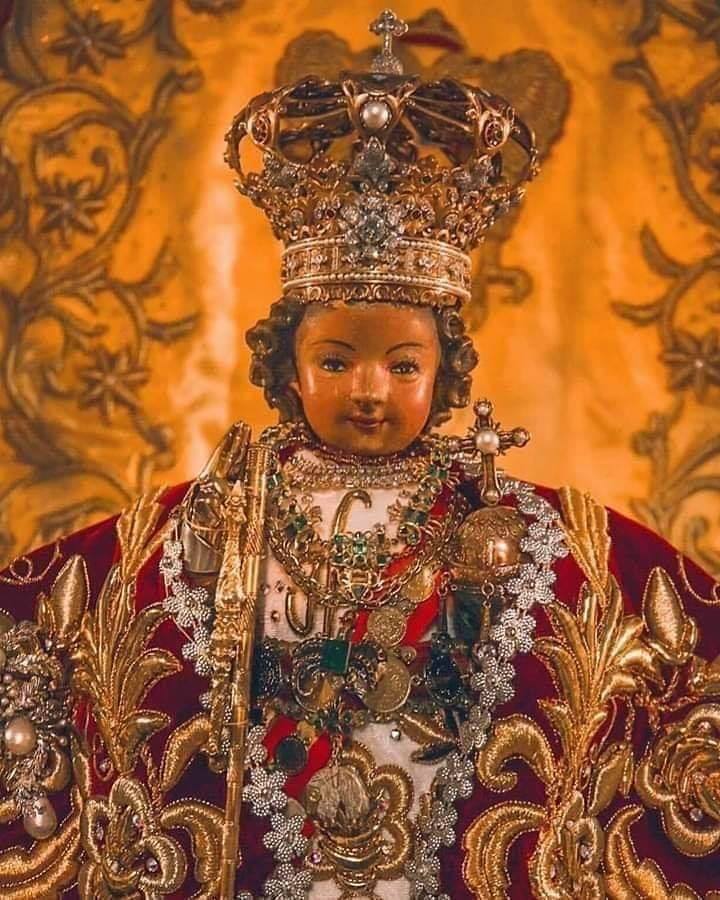
History of the Image of the Santo Niño De Cebu
The Santo Niño de Cebú was originally produced by Flemish artisans, according to a hagiography, based on a vision of Teresa of Ávila, the 16th century Discalced Carmelite mystic.
In early 1521, a Spanish expedition ordered by King Charles I and led by Ferdinand Magellan was on a voyage from Spain to find a westward route to the Spice Islands. After crossing the Atlantic and Pacific Oceans, on April 7, 1521, they landed in Limasawa, Southern Leyte, and met a local ruler named Raja Kulambu, who introduced him to Rajah Humabon, ruler of Cebu Island, and his chief consort, Hara Humamay. On April 14, Magellan presented them with three gifts: a bust of Christ as the Ecce Homo, an image of the Blessed Virgin Mary, and the Santo Niño as part of their baptism and strategic alliance.
As Humabon adopted the Catholic faith, he took the Christian name of “Carlos”, after Charles I. Humamay was christened “Juana”, after Joanna of Castile, Charles’ mother.[10][12] According to Antonio Pigafetta – Magellan’s memoir writer, along with the ruler, about 500 males along with the Queen and 40 women were also converted by Father Pedro Valderrama. At the ceremony, Raja Kulambu of Limasawa also converted and was given the name Don “Juan”, while his Muslim captain was named Don “Cristobal”.
A few days after the mass baptism, Magellan undertook a war expedition on the behalf of the newly named King Carlos, attacking Mactan Island and burning down hamlets which resisted. The residents led by Lapu Lapu defended Magellan’s attack with force, and Magellan died on April 27, in the Battle of Mactan, about three weeks after he had arrived in Philippines. After Magellan’s death, his Spanish colleagues left.
The next Spanish expedition arrived on April 27, 1565, led by Miguel López de Legazpi, again to gain a foothold for a colony to trade spices. He attempted a peaceful colonization, but these efforts were rejected. As a result, he opened fire on Cebu and burnt the coastal town down destroying 1,500 homes and possibly killing 500 people. In the ruins of this destruction, on April 28, the Spanish mariner Juan Camus found the image of the Santo Niño in a pine box. According to the local legend, the survival of the statue was seen as a sign of miracle by the colonizers, and ever since it has been believed to have miraculous powers.
The image of the Santo Niño is the oldest surviving Catholic relic in the Philippines.